- About Us
- Membership
- Professional Development
- Resources
- Acronym Dictionary
- Advocacy Tools
- FAQs
- Links
- LSP Evaluation Tools
- Mentorship Program
- NASP Practice Model
- National Association of School Psychologists (NASP)
- National School Psychology Week (NSPW)
- Newsletter
- Position Statements
- Resources for Educators & Parents
- Shortage & Workforce Committee
- Social Justice
- Speaker Bureau
- TASP Area Map
- TASP Journal
- TASP Talks Podcast
- Training Programs
- Member Center

|
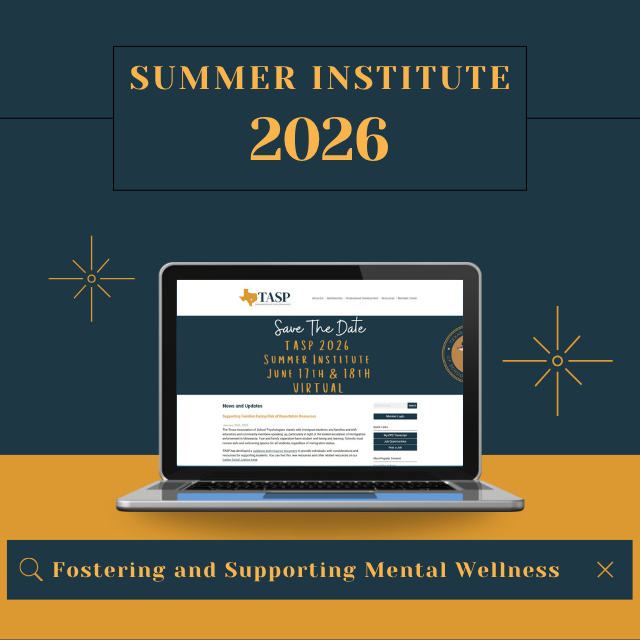 Session Details:LIVE SESSIONS Keynote Session: It Takes a Village Presenter(s): Judge Renee Rodriguez-Betancourt Session Description: As a juvenile court judge, I witness firsthand the consequences when a child's mental health needs go unmet. This presentation will provide a brief overview of Juvenile Justice System 101 while exploring how trauma, mental health, and adverse childhood experiences influence youth behavior. Grounded in the theme of Fostering and Supporting Mental Wellness, the session will highlight the critical role school psychologists and mental health professionals play in early identification, intervention, and collaboration to build resilience, support youth with mental health diagnoses, and prevent unnecessary involvement in the juvenile justice system. When we come together as a village, we can transform lives. Learning Objectives:
Session Skill Level: Intermediate
NASP Domains: Domain 4: Mental and Behavioral Health Services and Interventions, Domain 7: Family, School, and Community Collaboration
FS01: integrated perspectives: neurodiversity, lived experiences, and overlapping identities Presenter(s): Dr. danyelle s. goita beal and Olivia Baylor, LCPC Session Description: This session explores how neurodiversity, culture, migration, and identity collectively shape behavioral health experiences for refugee and migrant youth. Grounded in a strengths-based, trauma-informed, and culturally responsive framework, this presentation examines the role of lived experience and community knowledge in understanding behavior, engagement, and access to care. Participants will explore how historical and structural influences contribute to disparities affecting neurodivergent and culturally diverse communities and learn practical strategies for supporting youth and families through identity-affirming, culturally responsive approaches. Emphasis is placed on partnership, context, resilience, and meaningful community engagement. Learning Objectives:
Session Skill Level: Intermediate NASP Domains: Domain 2: Consultation and Collaboration, Domain 4: Mental and Behavioral Health Services and Interventions, Domain 8: Equitable Practices for Diverse Student Populations FS02: Supporting Children Within Their Ecology of Care: EMDR in School Settings Presenter(s): Ana M. Gomez, MC, LPC; Katherine Driskell, MSW, LICSW; Liz Epperson, LCSW & Isis Millward, LCSW Session Description: This presentation explores the implementation of EMDR therapy in school settings through a trauma-informed framework that recognizes how trauma often underlies emotional, behavioral, relational, and academic difficulties. Participants will learn how to identify and address the experiences at the core of students' struggles while working within the realities and demands of the educational environment. Learning Objectives:
Session Skill Level: Intermediate NASP Domains: Domain 4: Mental and Behavioral Health Services and Interventions FS03: Supervisor Series: Supervising Interns Learning to Implement MTSS Presenter(s): Dr. Arlene Ortiz Session Description: Ready to help your school-based mental health interns thrive? This session delivers actionable strategies to effectively guide interns through the multi-tiered system of supports (MTSS) framework. Participants will learn how to cultivate essential intern competencies—from data-based decision making to evidence-based practice—and explore professional evaluation systems to monitor growth. Elevate your supervision skills from a tiered system of supports perspective. Learning Objectives:
Session Skill Level: Intermediate NASP Domains: Domain 2: Consultation and Collaboration, Domain 10: Legal, Ethical, and Professional Practice FS04: From Dysregulation to Risk: Understanding the Link Between Early Relational Trauma, Escalating Behavior, and Long-Term Outcomes Presenter(s): Dr. Vicki Sanders Session Description: This training explores how early relational trauma shapes emotional regulation, behavior, and long-term developmental outcomes. Participants will examine how dysregulation, aggression, and other concerning behaviors can emerge as survival-based adaptations rather than simple defiance, while also considering how unresolved trauma may contribute to more serious behavioral patterns over time. The session will provide practical, relationship-based strategies for recognizing underlying needs, responding more effectively to dysregulated students, and intervening in ways that reduce escalation and support healthier developmental pathways. Learning Objectives:
Session Skill Level: Intermediate NASP Domains: Domain 2: Consultation and Collaboration, Domain 4: Mental and Behavioral Health Services and Interventions, Domain 6: Services to Promote Safe and Supportive Schools FS05: Applied AI in School Mental Health Practice: Live Demonstrations for Intervention Planning, Documentation, and Workflow Efficiency Presenter(s): Dr. Adam Lockwood Session Description: This session provides a practical overview of how artificial intelligence tools can support school mental health practice. Participants will explore general strategies for using AI to assist with common professional tasks. Emphasis will be placed on platform-agnostic approaches that can be applied across tools, with a focus on responsible use, professional judgment, and maintaining high-quality services. Learning Objectives:
Session Skill Level: Introductory NASP Domains: Domain 4: Mental and Behavioral Health Services and Interventions, Domain 8: Equitable Practices for Diverse Student Populations, Domain 10: Legal, Ethical, and Professional Practice FS06: Building Wellness Practices that Last Presenter(s): Dr. Molly Lopez and Jennifer Baran-Prall Session Description: This session introduces the Center for Mental Health Implementation Support (CMHIS) and core practices that help schools and districts successfully implement and sustain mental health initiatives. Participants will explore how to engage communities, conduct meaningful needs assessments, and identify factors that influence implementation. The session also highlights practical strategies for turning ideas into action and evaluating impact. Through real-world examples and interactive activities, attendees will gain tools to design, implement, and sustain effective, community-informed mental health programs that improve outcomes for students, staff, and school systems. Learning Objectives:
Session Skill Level: Introductory NASP Domains: Domain 1: Data-Based Decision Making, Domain 7: Family, School, and Community Collaboration, Domain 9: Research and Evidence-Based Practice FS07: Supporting Newcomers in Texas: Definitions, Demographics, and RMTAC Services Presenter(s): Dr. Mutsa Majero and Luz Chapa, MEd, LPC Session Description: As newcomer populations continue to grow across Texas, schools play a critical role in fostering belonging, resilience, and academic success. This session provides an overview of newcomer communities in Texas, including key demographic trends, terminology, and common migration experiences. Participants will explore the impact of trauma, migration stress, and cultural adjustment on student functioning and learn trauma-informed, culturally responsive strategies to support newcomer students and families. The session will also introduce RMTAC’s services and resources available to help schools strengthen support for newcomer communities. Learning Objectives:
Session Skill Level: Introductory NASP Domains: Domain 2: Consultation and Collaboration, Domain 4: Mental and Behavioral Health Services and Interventions, Domain 6: Services to Promote Safe and Supportive Schools. FS08: Systemic Suicide Prevention Strategies for Rural Schools Presenter(s): Dr. Kurt Michael and Whitney Yoder Session Description: As newcomer populations continue to grow across Texas, schools play a critical role in fostering belonging, resilience, and academic success. This session provides an overview of newcomer communities in Texas, including key demographic trends, terminology, and common migration experiences. Participants will explore the impact of trauma, migration stress, and cultural adjustment on student functioning and learn trauma-informed, culturally responsive strategies to support newcomer students and families. The session will also introduce RMTAC’s services and resources available to help schools strengthen support for newcomer communities. Learning Objectives: At the conclusion of this program, participants will be able to:
Session Skill Level: Intermediate NASP Domains: Domain 6: Services to Promote Safe and Supportive Schools, Domain 9: Research and Evidence-Based Practice, Domain 10: Legal, Ethical, and Professional Practice ON DEMAND SESSIONS FS09: Ethical AI Use in School-Based Mental Health: Bias, Disclosure, and Responsible Practice (2 CPDs) Presenter(s): Dr. Adam Lockwood Session Description: This session examines ethical considerations related to the use of artificial intelligence in school-based mental health practice. Topics include responsible use, bias awareness, disclosure practices, and maintaining appropriate professional judgment when using AI tools. The session emphasizes broad principles that can guide decision-making across different platforms and evolving technologies. Learning Objectives:
Session Skill Level: Introductory NASP Domains: Domain 8: Equitable Practices for Diverse Student Populations, Domain 9: Research and Evidence-Based Practice, Domain 10: Legal, Ethical, and Professional Practice FS10: Trauma-Informed Strategies for Survivors of Disaster, Conflict, and Violence (3 CPDs) Presenter(s): Dr. Rocio Chang Session Description: Caring Through Crisis: Trauma-Informed Strategies for Latino Children Survivors of Disaster, Conflict, and Violence will review the impact of trauma utilizing a Radical Healing Framework and a Trauma Affect Regulation: Guide for Education and Therapy Model (TARGET), which is an educational and therapeutic approach for the prevention and treatment of developmental trauma disorders, posttraumatic stress disorder, and other stress-related disorders. Learning Objectives:
Session Skill Level: Intermediate NASP Domains: Domain 4: Mental and Behavioral Health Services and Interventions FS11: Building Compassionate and Caring School Communities Through Community Resiliency (3 CPDs) Presenter(s): Dr. Rocio Chang Session Description: This session will focus on understanding how trauma impacts students' behaviors and how to apply trauma-informed principles to decrease reactivity and build community resilience. Learning Objectives:
Session Skill Level: Intermediate NASP Domains: Domain 1: Data-Based Decision Making, Domain 4: Mental and Behavioral Health Services and Interventions, Domain 8: Equitable Practices for Diverse Student Populations |

Most Popular Content
Our Sponsors